Missouri’s weather doesn’t go easy on outdoor structures. Between humid summers, freeze-thaw winters, and spring storms that bring wind, rain, and hail, a pergola needs to hold up year after year, not just look good on day one.
The material you choose determines how long it lasts, how much upkeep it needs, and what it truly costs over time.
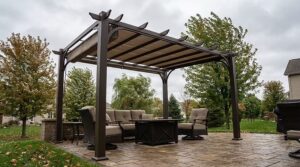
Overview of the Most Popular Pergola Materials Available in Missouri
Missouri homeowners building or buying a pergola have more material options today than ever before. Each one brings a different combination of upfront cost, durability, maintenance requirement, and visual character.
|
Material |
Upfront Cost |
Maintenance Level |
Lifespan (Missouri Climate) |
Best Application |
|
Pressure-treated pine |
Low |
High |
10–20 years |
Budget builds, DIY projects |
|
Cedar |
Moderate |
Moderate |
15–25 years |
Residential, natural aesthetic |
|
Redwood |
High |
Low–Moderate |
25–30+ years |
Premium custom builds |
|
Douglas fir (rough-sawn) |
Moderate |
Moderate |
15–25 years |
Timber-frame, rustic designs |
|
Aluminum |
Moderate–High |
Very Low |
30–50+ years |
Low-maintenance, modern look |
|
Vinyl / PVC |
Moderate |
Very Low |
25–40 years |
Clean, uniform appearance |
|
Steel |
High |
Low |
30–50+ years |
Heavy-duty, architectural builds |
|
Fiberglass |
High |
Very Low |
30–50+ years |
Premium, high-humidity areas |
The right choice depends on your climate zone, budget, and how much upkeep you’re realistically willing to commit to year after year.
Why Choosing the Right Pergola Material Matters in Missouri
Pergola material selection is not just an aesthetic decision. In Missouri’s climate, it directly determines how much structural integrity the pergola retains over time, and how much money and effort you spend maintaining it.
Structural Performance
Different materials respond differently to load, accumulated snow, strong wind, or the downward pressure of a climbing plant like wisteria. Engineered materials like steel and aluminum hold up more predictably over decades. Natural wood requires more active upkeep to retain those same properties.
Moisture Resistance
Missouri’s humidity runs well above the national average, particularly from May through September. Prolonged moisture exposure causes untreated or under-maintained wood to check, warp, and rot, sometimes within the first few years. Materials with inherent moisture resistance perform significantly better here.
UV Degradation
Missouri’s long outdoor season brings moderate to high UV exposure. Fading, surface chalking, and material breakdown affect lower-grade composites, some vinyl formulations, and unfinished wood more than products rated specifically for UV resistance.
Thermal Movement
Missouri’s temperature swings, from below-freezing winters to 95°F summer afternoons, are substantial. Materials with high thermal expansion coefficients, like certain vinyl products, can develop joint gaps or surface buckling if not installed with proper spacing allowances.
Total Cost Of Ownership
A pressure-treated pine pergola costs less upfront. But factor in sanding, staining, and sealing every two to three years in Missouri’s humid climate, and those costs compound quickly. Lower-maintenance materials often deliver a better return over a 15–20 year lifespan, even when their purchase price is higher.
The right material choice is a structural and financial decision, one that plays out over two decades.
How Missouri’s Climate Affects Each Pergola Material
Missouri’s four-season weather is the stress test every pergola material has to pass. Here’s how each one holds up where it counts.
Wood: Pressure-Treated Pine and Cedar
Wood’s biggest challenge in Missouri is high summer humidity, it causes expansion, contraction, and seasonal checking (surface cracks that develop as boards absorb and release moisture).
Pressure-Treated Pine
-
Resists decay through chemical preservatives
-
Still prone to warping without consistent sealing
-
Annual or biennial sealing is effectively mandatory in Missouri’s climate
Cedar
-
Natural oils slow moisture absorption and resist insect damage without chemical treatment
-
The stronger wood-based choice for Missouri conditions
-
Still benefits from a quality sealant or stain every 2–3 years
What Both Share: Freeze-thaw cycles compound wear on all wood types. Repeated seasonal expansion and contraction loosen joinery, work fasteners free, and cause surface cracking, particularly in untreated or under-sealed boards.
Aluminum
Aluminum doesn’t absorb moisture, doesn’t rust, and resists thermal movement through Missouri’s wide temperature swings, making it one of the most climate-stable pergola materials available.
-
Powder-coated finishes resist UV fading and surface chalking through long, sun-intense summers
-
No seasonal sealing, staining, or painting required
-
Periodic cleaning is typically all the upkeep needed from year to year
Vinyl / PVC
Vinyl is moisture-proof and impervious to rot and insect damage, real advantages in Missouri’s humid summers.
-
Expands and contracts more noticeably than aluminum through Missouri’s temperature swings
-
Lower-grade profiles can become brittle in sub-freezing temperatures
-
Thicker-wall, four-season-rated profiles manage this risk well, but quality varies significantly between products
-
Always verify UV resistance rating and temperature performance spec before purchasing
Steel and Composite
Steel
-
Excellent structural rigidity, the right choice for wind-exposed locations or demanding custom builds
-
The main vulnerability in Missouri’s humid environment is surface rust when the protective coating is chipped or scratched
-
Powder-coated or galvanized finishes handle this well but require periodic inspection
Composite
-
Capped exterior resists moisture absorption and UV fading effectively in Missouri’s climate
-
Unlike wood, composite does not require seasonal sealing to maintain structural performance over time
For Missouri homeowners prioritizing longevity with low maintenance, aluminum and composite are the strongest long-term performers. For those who prefer natural wood and will commit to regular upkeep, cedar is the best available choice.
How to Choose the Best Pergola Material for Your Missouri Home and Budget
No single material is the right choice for every homeowner. The best decision comes down to four practical factors.
Maintenance Tolerance
If you’re committed to periodic staining and sealing, cedar performs well and offers a natural aesthetic that manufactured materials can’t fully replicate. If you want to build it and largely forget about it, aluminum or high-grade vinyl are the better fits for Missouri’s climate.
Design Intent
Timber-frame and rustic designs call for rough-sawn lumber, the proportions and texture simply can’t be replicated with thin-wall aluminum or vinyl. Contemporary designs are better served by aluminum or steel. Traditional painted-wood aesthetics with low maintenance points toward fiberglass or quality vinyl.
Budget: Upfront And Long-Term
Pressure-treated pine costs the least upfront. Cedar sits in the mid-range. Aluminum and quality vinyl run moderately higher. Steel and fiberglass are premium. But maintenance costs over 15–20 years shift the total cost ranking considerably. Missouri’s humidity demands more frequent attention to wood surfaces than drier climates would.
Structural Requirements
Large pergola footprints, heavy climbing plants, roofing panel additions, or integrated lighting and fan loads all require structural consideration. Steel and aluminum handle these demands most reliably. Vinyl has span limitations. Wood performs well structurally when properly sized and maintained.
The right material holds up in your specific Missouri climate zone, fits your realistic maintenance habits, and meets any local regulatory requirements.
Common Mistakes Missouri Homeowners Make When Choosing Pergola Materials
Most material regrets are completely preventable. Here’s what to watch out for before making your final decision.
-
Judging by photos alone: Product photography flatters everything. Always view materials installed in person before committing
-
Underestimating Missouri’s humidity: Pressure-treated doesn’t mean maintenance-free. Neglected wood shows visible wear within 3–5 years
-
Ignoring end-grain protection: Unprotected post tops and beam ends are where rot starts first. Always specify end-grain sealing
-
Skipping thermal expansion checks on vinyl: Missouri’s temperature extremes cause real, cumulative movement. Always ask how a product handles expansion
-
Under-specifying post material: Any post going into soil or concrete must use ground-contact-rated lumber, UC4A or UC4B minimum
Avoiding these mistakes starts with treating material selection as a structural and long-term financial decision, not just an aesthetic one.
FAQs
What is the best pergola material for humid climates like Missouri?
Cedar, aluminum, and fiberglass are the strongest performers. Cedar offers natural rot resistance, aluminum needs virtually no moisture-related maintenance, and fiberglass combines a wood-like appearance with excellent moisture resistance. Pressure-treated pine works well but demands more active upkeep.
How long does a wood pergola last in Missouri?
A properly maintained cedar pergola typically lasts 15–25 years. Pressure-treated pine averages 10–20 years with regular staining or sealing. Without consistent maintenance, both materials show significant degradation within 5–8 years.
Is vinyl or aluminum better for a Missouri pergola?
Both are solid low-maintenance options, but aluminum is more dimensionally stable through Missouri’s freeze-thaw and summer heat cycles. Vinyl is more susceptible to thermal expansion and has span limitations on larger structures, making aluminum the slightly stronger long-term choice for most Missouri homeowners.
Does pergola material affect resale value in Missouri?
Yes. A structurally sound pergola in cedar, aluminum, or premium composite adds to outdoor living appeal. A deteriorating wood pergola can become a liability. Permitted builds with quality materials consistently perform better in appraisal and buyer perception.
What pergola material requires the least maintenance in Missouri?
Aluminum and fiberglass require the least upkeep, periodic cleaning is typically all that’s needed. Quality vinyl comes close, though joint integrity should be checked periodically. All wood materials require regular staining, sealing, or painting to maintain structural integrity over time.
Can I use rough-sawn timber for a pergola in Missouri?
Yes, rough-sawn Douglas fir and pine are well-suited to timber-frame and post-and-beam pergola designs. Specialty suppliers like Midwest Timber & Beam Supply in Highlandville, MO, stock non-standard dimensional lumber that general yards don’t carry. Proper end-grain sealing and periodic finishing are essential for longevity.